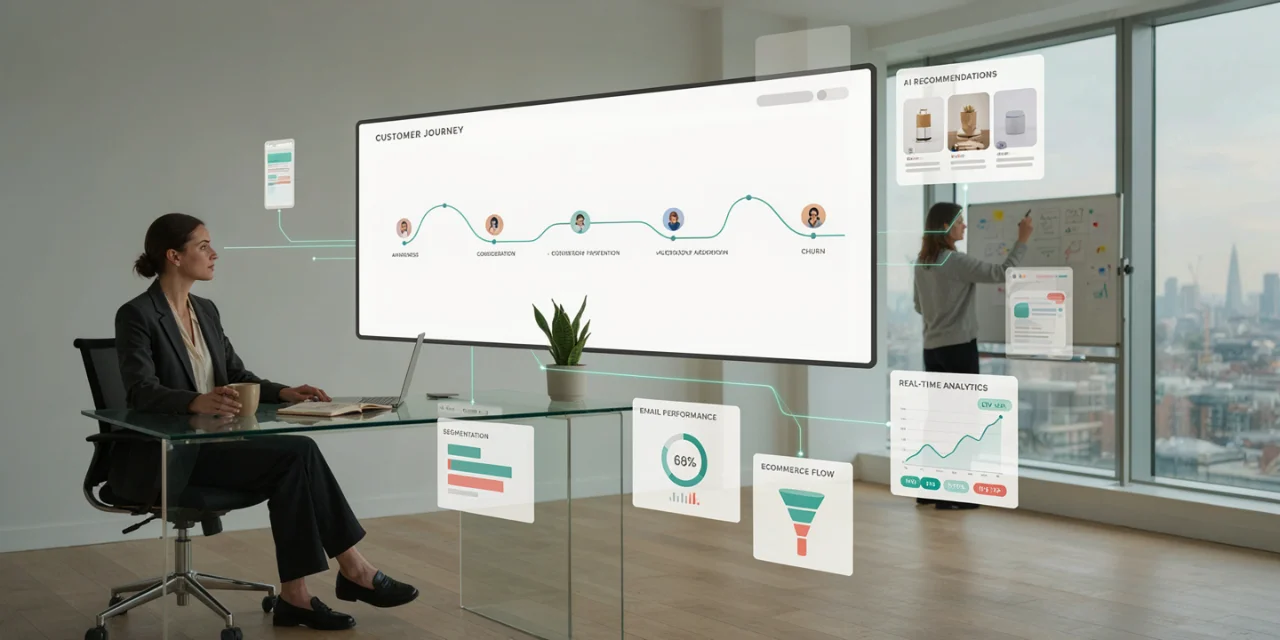
A website is no longer simply a digital brochure. For many UK businesses, it is where customers discover products, compare options, ask questions and make purchasing decisions. As a result, improving website conversion rates has become closely connected to customer experience, marketing technology and data quality.
Recent UK ecommerce data illustrates why optimisation remains important. Statista reported that approximately 1.67 percent of visits to ecommerce websites in Great Britain converted to purchases in the first quarter of 2026. However, averages vary significantly by industry, audience and business model, so companies need to understand their own customer journey rather than rely on a single benchmark.
Understanding What Customers Expect in 2026
UK consumers increasingly expect websites to be fast, relevant and easy to navigate. Meanwhile, the growth of AI is changing how people research products and interact with businesses.
Research from the Data and Marketing Association in September 2026 found that customer loyalty is changing as consumers balance familiarity, cost pressures, trust and concerns about data use. Therefore, businesses need to make every digital interaction useful rather than simply adding more technology.
A successful website should answer important questions quickly. Customers should understand what the business offers, why it is relevant to them and what action they should take next.
Simplifying the Customer Journey
One of the most practical ways to improve conversions is to remove unnecessary friction. Complicated navigation, unclear calls to action, lengthy forms and confusing checkout processes can make customers hesitate.
Consequently, businesses should examine the complete journey from the first landing page through to the final conversion. Each page should have a clear purpose and guide visitors naturally toward the next step.
Additionally, mobile users deserve particular attention. A website that works well on a desktop but feels slow or difficult to use on a smartphone can create unnecessary barriers.
Using AI to Create More Relevant Experiences
Artificial intelligence is becoming an increasingly important part of the MarTech ecosystem. Businesses can use AI to analyse customer behaviour, personalise content, support customer service and identify patterns within large datasets.
However, AI should improve the customer experience rather than make interactions feel impersonal. UK government guidance on AI agents highlights potential uses including customer queries, product recommendations and marketing campaigns, while also emphasising responsible use and consumer confidence.
Similarly, recent UK consumer research from Invoca found that 79 percent of surveyed consumers would switch to a competitor that responds faster. Therefore, speed and usefulness should remain more important than simply deploying AI for its own sake.
Building Better Customer Experience Strategies
Customer experience strategies should connect every stage of the digital journey. Website design, email communication, advertising, customer support and post purchase engagement should feel like parts of the same experience.
Moreover, personalisation can help businesses present more relevant content to different audiences. Returning visitors might see recommendations based on previous interactions, while new visitors may need clearer introductory information.
The goal is not to personalise everything. Instead, companies should use customer information where it genuinely improves relevance and convenience.
Making Data Driven Marketing More Effective
Data driven marketing can reveal where customers leave a website, which pages generate engagement and which campaigns bring high quality visitors. However, collecting more data does not automatically produce better decisions.
Businesses need reliable measurement and clear objectives. They should distinguish between traffic, engagement and actual commercial outcomes. Consequently, marketing teams can focus their optimisation efforts on areas that have a measurable relationship with business performance.
The UK Business Data Survey 2026 also shows that AI adoption and data practices are becoming increasingly connected. Among UK businesses using AI, larger organisations were more likely to report integrating AI into existing business systems.
Improving Content and Calls to Action
Website visitors need clear reasons to continue. Strong content should explain benefits rather than overwhelm users with technical information or excessive promotional language.
Furthermore, calls to action should match the visitor’s stage in the buying journey. Someone discovering a service for the first time may need an educational resource, while an existing customer may be ready to request a quote or complete a purchase.
In contrast, using the same call to action across every audience can create a disconnected experience. Businesses should therefore test different messages, layouts and offers based on customer intent.
Using Marketing Technology More Strategically
Marketing technology can connect analytics, customer relationship management, automation, advertising and personalisation. Nevertheless, adding more platforms does not necessarily improve conversions.
The real opportunity comes from connecting existing systems so that marketing teams can understand customers more effectively. Technology insights can help identify new opportunities, while Marketing trends analysis can reveal how consumer behaviour is changing.
Additionally, digital marketing innovations such as AI powered search and conversational experiences are changing how customers discover businesses. Adobe’s 2026 research highlights the growing importance of AI powered discovery and personalised customer experiences.
Testing Before Making Major Changes
Conversion optimisation should be treated as an ongoing process rather than a one time website redesign. Businesses can test headlines, page layouts, forms, product descriptions, navigation and calls to action.
However, each experiment should have a clear objective. Testing too many changes simultaneously can make results difficult to interpret.
Similarly, businesses should look beyond the conversion itself. A change that increases form submissions but produces poor quality leads may not represent genuine improvement.
Preparing for the Next Stage of Digital Commerce
The next phase of website optimisation will increasingly combine AI, personalisation, analytics and conversational experiences. At the same time, customers will continue to expect transparency and control.
Research from Adobe indicates that organisations are investing heavily in personalised experiences, while data readiness and integration remain important challenges for scaling AI powered customer engagement.
Therefore, UK businesses should focus on building a strong data foundation alongside customer focused design. A sophisticated technology stack is useful only when it helps customers find information, make decisions and complete actions more easily.
Insights for Improving Website Conversions
The most effective approach in 2026 is to connect technology with genuine customer needs. Businesses should simplify journeys, improve mobile experiences, analyse customer behaviour and use AI where it creates measurable value.
Meanwhile, customer experience strategies should remain central to every optimisation decision. Data driven marketing can identify opportunities, while testing can reveal which improvements actually influence customer behaviour.
As the MarTech ecosystem continues to evolve, companies that combine useful technology with clear communication and thoughtful experiences can create stronger digital journeys. Website optimisation is therefore becoming less about isolated design changes and more about creating a connected experience from discovery to conversion.
Explore MarTechInfoPro for more expert perspectives on marketing technology, digital innovation and customer experience.